

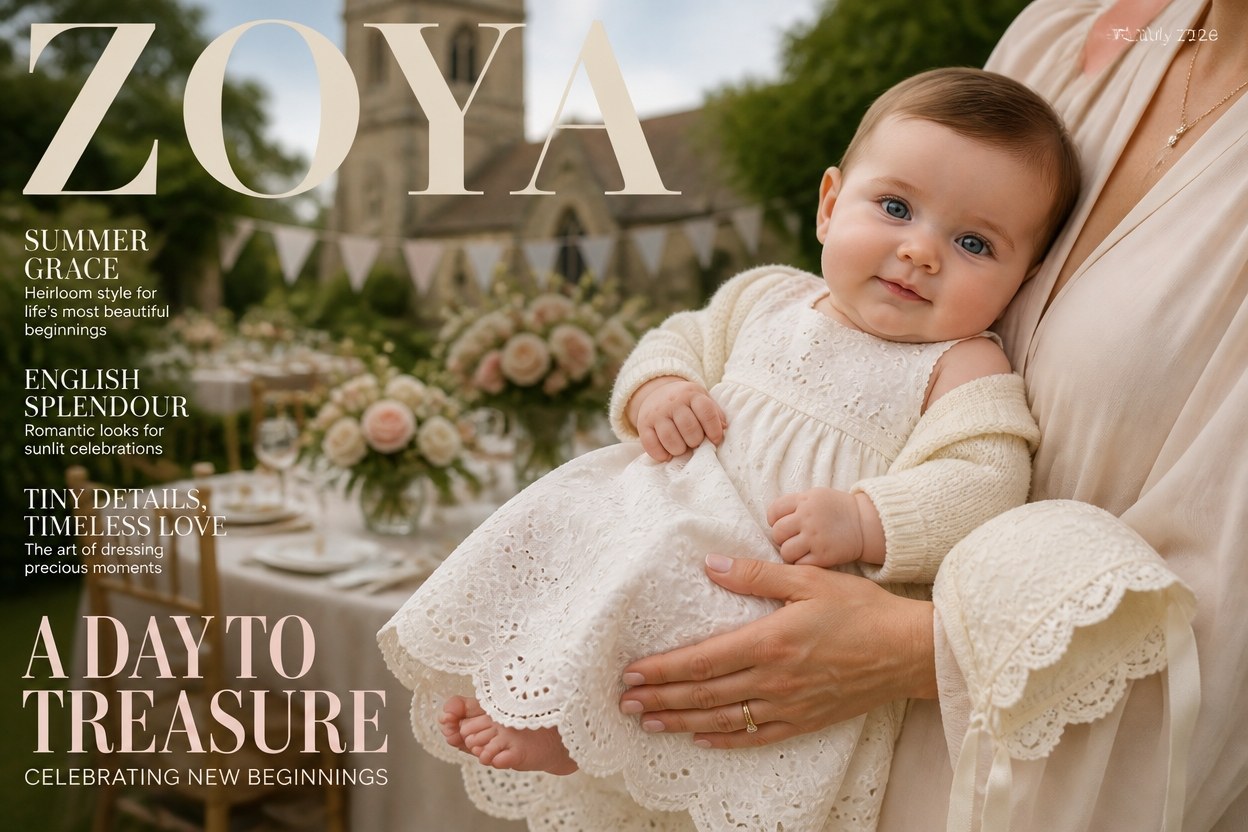
Baby dresses for a British summer christening: fabric, fit and cost, honestly compared
It was the second Saturday of July, in a flint church just outside Bury St Edmunds, and my niece was eleven weeks old. The nave was cool enough that I wished I had brought a cardigan. Forty minutes later we were standing on my sister's lawn in full sun, the thermometer on the kitchen window reading twenty-nine degrees, and that same baby was scarlet in the face and screaming inside three layers of lined polyester. My sister ended up feeding her in the shade of the garage in nothing but a vest, while a photographer waited for a family group shot that never happened. That was the afternoon I started taking baby dresses seriously as a practical problem rather than a pretty one.
I run a content studio, which means I cannot look at anything without wanting the numbers behind it. So over the following two summers I kept notes: six christenings, two of my own children out of that stage and plenty of other people's babies still in it, a spreadsheet of fabrics, temperatures, sizes ordered versus sizes actually worn, and what each outfit cost per hour of wear. This is what came out of it.
The short version, in three points
- A British christening day contains two different climates. A stone church in July sits somewhere around eighteen to twenty degrees; the garden reception an hour later can be ten degrees warmer. The outfit has to work in both, which means the warmth needs to be removable rather than built in.
- Fibre content predicts comfort better than price does. Cotton absorbs roughly eight per cent of its own weight in moisture before it feels damp against skin. Polyester manages about 0.4 per cent. On a hot afternoon that difference is the whole argument.
- Buy for the date, not for the ordering week. A baby grows around twenty-five centimetres in the first year. Six weeks between ordering and the ceremony is genuinely enough to change the size you need.
Two climates in one afternoon, and why that shapes the whole outfit
Every christening I have been to in July has followed the same shape. Arrive at a church that has been holding its own temperature since the fourteenth century. Sit through a service of forty to fifty minutes, usually with a font at the front and a photographer at the back. Walk out into whatever the Met Office has decided to do that day. Then two or three hours of drinks, cake, bunting and grandparents on a lawn, a village hall with the doors propped open, or a pub garden if the family has been sensible.
The church is colder than you expect
Thick masonry lags badly behind the outside air. Even during last summer's mid-July hot spell, the churches I sat in stayed pleasantly cool, and several were noticeably chilly in the pews furthest from the door. Babies under six months regulate their temperature poorly in both directions, which is why the classic advice from health visitors is one more light layer than an adult would need indoors. In a cool church, that is real.
The garden hour is what catches people out
Then the doors open. In full July sun on an unshaded lawn, the perceived temperature is far higher than the shade reading, and a baby held against a warm adult body is effectively wearing an extra person. This is the hour when a heavily lined dress becomes a problem, and the hour that most of the photographs get taken in.
The design conclusion is straightforward once you see it that way. Warmth should be a layer you can remove in ten seconds, not something stitched into the lining. A light dress plus a fine knit cardigan, a bolero or a shawl gives you both climates. A single heavy dress gives you one, and it is the wrong one.
Fabric weight and breathability, compared properly
I stopped reading product photographs and started reading composition labels. Grams per square metre, which is how fabric weight is measured, tells you a great deal, and the fibre tells you the rest. Here is how the common options for a summer ceremony actually behave.
| Fabric | Typical weight (gsm) | Breathability | Handles a hot lawn | Creases in the car seat |
|---|---|---|---|---|
| Cotton lawn or voile | 60 to 90 | Excellent | Yes | Some |
| Broderie anglaise (cotton) | 100 to 130 | Excellent | Yes | Some |
| Cotton poplin | 110 to 140 | Very good | Yes | Moderate |
| Linen blend | 120 to 180 | Excellent | Yes | Heavily |
| Soft tulle over cotton lining | 90 to 140 | Good | Usually | Very little |
| Viscose or modal blend | 100 to 150 | Good | Yes | Moderate |
| Duchess satin or lined polyester | 160 to 250 | Poor | No | Very little |
What those numbers mean at the reception
The two columns that matter most on the day are breathability and weight, and they usually move together. Natural fibres move moisture away from the skin and let it evaporate; synthetics largely do not, which is why a lined polyester dress can feel clammy within twenty minutes even when the shade temperature is perfectly reasonable. For a baby who cannot tell you what is wrong, the symptoms show up as a flushed neck, damp hair at the temples and a mood that collapses at exactly the wrong moment.
That does not mean tulle is banned. A single layer of soft tulle over a cotton lining is a very different garment from four layers of stiff netting over a full polyester underdress. Look for a cotton lining against the skin and airy, unstructured net above it, and check that the neckline and armholes are bound in soft cotton rather than a hard synthetic trim. Most of the lighter summer options in the baby occasion dresses range are built exactly this way.
My thirty-second checks before I buy
Read the composition label and look for at least sixty per cent natural fibre next to the skin. Hold the garment up to a window and count the layers. Scrunch a handful for ten seconds and see whether it springs back or stays crumpled, because a dress that creases in the car will look creased in every photograph. Finally, run a fingertip along every internal seam and the label position, since anything scratchy at the neck will be discovered at high volume during the vows.
Sizing baby dresses by age: what the growth data actually says
This is where most of the money gets wasted, and it is entirely avoidable. British baby clothing is sized by age in months, but the underlying measurement is height in centimetres, and babies grow at a pace that makes age labels a rough guide at best.
| UK size label | Height guide | Typical age at that height |
|---|---|---|
| Newborn | up to 56 cm | 0 to 4 weeks |
| 0 to 3 months | 56 to 62 cm | 1 to 3 months |
| 3 to 6 months | 62 to 68 cm | 3 to 6 months |
| 6 to 9 months | 68 to 74 cm | 6 to 9 months |
| 9 to 12 months | 74 to 80 cm | 9 to 12 months |
| 12 to 18 months | 80 to 86 cm | 12 to 18 months |
| 18 to 24 months | 86 to 92 cm | 18 to 24 months |
Why the dress you ordered in May may not fit in July
An average baby gains roughly twenty-five centimetres in the first year and around twelve in the second. Broken down, that is close to a centimetre a week in the first six months. Order eight weeks ahead for a four-month-old and you are dressing a different child by the time the ceremony arrives. Measure your baby's current length the week you order, add a centimetre for every week between then and the date, and size against that number rather than against the age on the label.
The two rules I now apply without exception
First, size up rather than down. A dress that is slightly long on a baby who is being carried looks entirely intentional; one that is tight across the chest or that rides up over the nappy does not, and it will be uncomfortable for hours. Second, for anyone crawling or newly walking, check the hem length against the knee. A gown that pools on the floor is beautiful in the arms and a trip hazard at the buffet. Second children make this obvious: keep the receipt, and try everything on properly a fortnight before, not the night before.
What genuinely justifies the cost of a dress worn once
Here is the honest arithmetic, because I dislike the assumption that occasion wear is automatically extravagant. Take a forty-pound dress. Worn only at the ceremony, that is forty pounds for four hours, which is about ten pounds an hour, roughly the price of a family cinema trip nobody remembers.
Now count properly. In the summers I tracked, the same dress went to the christening, to two family weddings, to a first birthday tea, to a professional newborn-to-one photo session, and to Christmas dinner. Five to six wears is normal if you buy something that is not obviously a costume. That takes the figure to seven or eight pounds a wear. Resale on Vinted or at an NCT nearly-new sale typically recovers thirty to fifty per cent of a good-condition natural-fibre dress, and dresses often pass sideways to a cousin or a friend afterwards, which pushes the real cost lower still.
Where the money is well spent
Cotton or linen content next to the skin, French or bound seams that survive a hot wash, poppers or a full-length back opening rather than a narrow head hole, generous seam allowances that let a hem down, and a lining that is a separate fabric rather than a fused backing. Those are the features that decide whether a garment reaches a second child intact.
Where it is not
Heavy beading near the face, stiff netting, dry-clean-only labels on a garment that will meet cake and milk, and any trim a baby can pull off and put in their mouth. Those add cost, add risk and add nothing to a photograph. When I compare pieces in the baby dress collection I look at the fastening and the lining first, then the price.
Bringing it together before your July date
So, the summary. Dress for two climates and keep the warmth removable. Read the composition label before the product description, and treat sixty per cent natural fibre as your floor. Measure in centimetres the week you order and add a centimetre a week until the ceremony. Then judge the price across five or six wearings and a likely resale, not across one Saturday afternoon.
With the school holidays now under way and the ceremony diary filling up between now and September, the sensible move is to order early enough to try the dress on with a fortnight to spare. Have a look through the baby dresses at ZOYA, check the fabric and the length against the notes above, and you will spend the day watching your baby rather than worrying about what she is wearing.
Read also:
- Smart Christening Dresses for Girls 2025 – Top Trends & Elegant Styling
- Perfect Summer Girls’ Dresses for Walks, Holidays & Everyday Fun – 2024 Trends
- Guide to choosing boleros and cardigans for UK First Holy Communions
- How to Choose the Right Formal Dress for Girls UK Guide
- From Playground to Party: The Ultimate Guide to Versatile Girls’ Dresses