

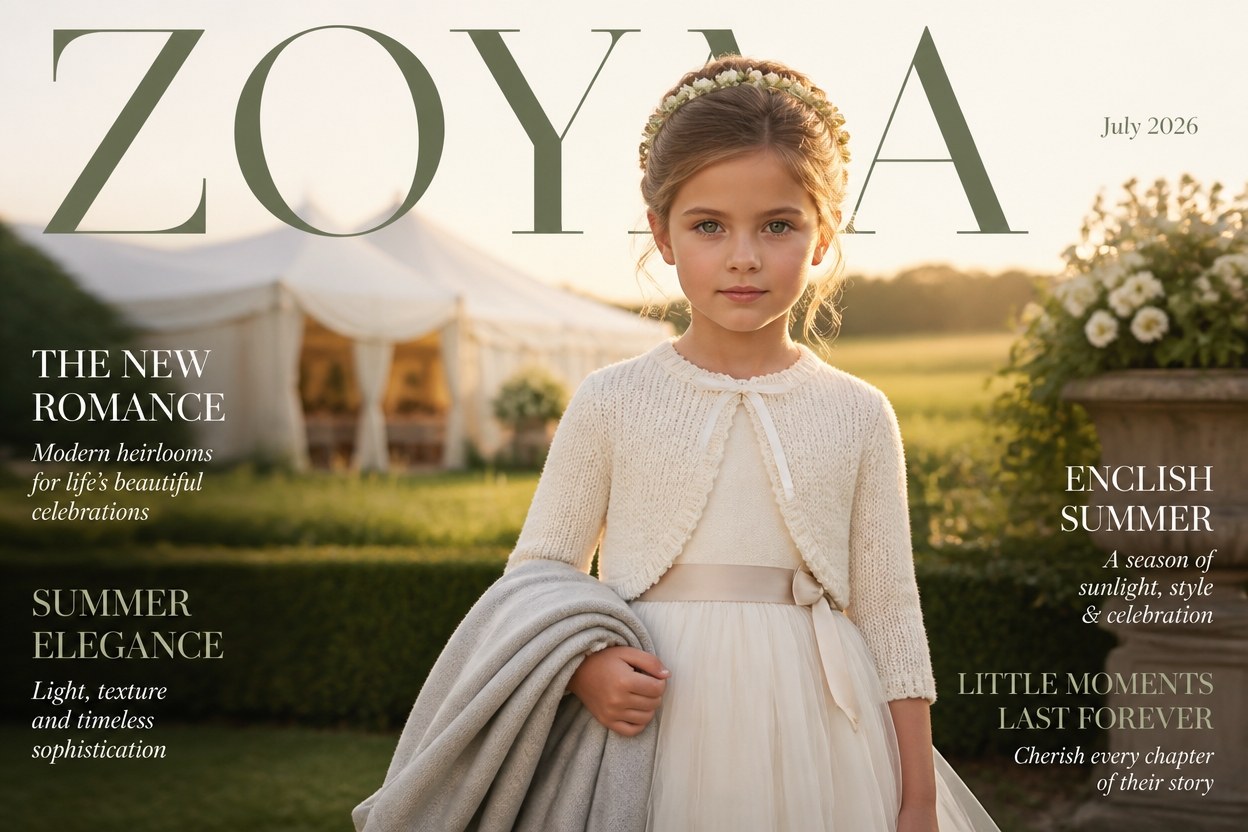
The Quiet Genius of the Cover-Up: Boleros and Coats for Girls in a British July
Half past six on a Saturday in July, somewhere between Chipping Norton and the last bar of phone signal. The ceremony was glorious. The garden drinks were photographed to within an inch of their lives. And now the sun has slipped behind the beech trees, the temperature has dropped a decisive eight degrees, and a seven-year-old flower girl in three layers of ivory tulle is standing at the mouth of a marquee with her arms folded and her lips going faintly blue. Someone's aunt appears with a pashmina the colour of cooked salmon and drapes it over the child like a dust sheet over a piano. I have been that aunt. I am not proud of it. And it is precisely that scene, repeated in fields and village halls across the country every summer weekend, that convinces me boleros and coats for girls are the most quietly intelligent pieces in a child's occasion wardrobe — and the most routinely under-judged.
The British Summer Paradox: Why Boleros and Coats for Girls Deserve a Critic's Attention
Britain is, as far as I can tell, the only country where a family can plan an outdoor July wedding and pack a coat without anyone laughing. We are a nation of 24 degrees at two o'clock and 13 degrees at nine, of church interiors that hold the cold of February well into August, of marquees whose canvas walls are decorative rather than thermal. The July calendar makes this worse rather than better: the school term ends in the third or fourth week of the month across England and Wales, Scotland has already broken up, and the resulting fortnight is a dense traffic jam of weddings, christenings, leavers' parties, summer fêtes and garden receptions. Every one of them starts in sunshine and ends in a draught.
So here is my first question, and I ask it without much patience: why do we spend three months choosing a dress and three minutes choosing the garment that will sit over it in half the photographs? The dress is ordered in spring, fitted, discussed, agonised over. The layer is grabbed from the hall cupboard at eight in the morning, or worse, borrowed from an adult in the car park. The result is a beautifully considered outfit finished with an accident.
A good cover-up is not an apology for the weather. It is a design decision. It changes the silhouette, sets the colour temperature of the whole look, and determines whether a child spends the reception dancing or clamped to a parent's side. Properly chosen, boleros and coats for girls do something no accessory can: they make the dress work for eleven hours instead of four. That is not a minor practical footnote. That is the difference between a memorable day and a photographed one.
Judging the Cut: Where a Bolero Should End, and Where the Trouble Begins
Cut is where most cover-ups are won or lost, and it is astonishing how few people examine it. A bolero has one structural job: to frame the bodice without interrupting it. That means the hem must land at one of two places — at the natural waist, exactly where the bodice meets the skirt, or a clean two to three centimetres above it. Anything that stops mid-bodice looks like a garment that has shrunk in the wash. Anything that drops below the waist seam cuts a small person into two unequal halves and shortens the leg line, which on a child of six or nine is the last thing you want.
Then the shoulder. The seam should sit on the shoulder point, full stop. A dropped shoulder is a lovely thing on an adult's oversized cardigan and a disaster on a four-year-old, because it collapses the frame and makes the arms look boneless. Run a finger along that seam before you commit. If it sits a centimetre out, the whole thing will read as borrowed.
Sleeve length is the detail I would defend most fiercely. Three-quarter is the intelligent choice for a summer ceremony: it covers the upper arm, which is where children genuinely feel the cold, while leaving the wrist free for eating, waving and the inevitable business of carrying a basket. Full-length sleeves in July are optimistic; cap sleeves are decorative rather than useful. And the closure? One ribbon tie or a single covered hook at the throat is elegant and, crucially, undoable by the child herself. A full button placket introduces a row of competing hardware down the front of a dress that has usually earned its own centre of attention.
The front edges matter too. A good bolero's opening echoes the neckline beneath it rather than fighting it. Look for that echo in a properly cut bolero and you will find that the garment almost disappears into the outfit, which is exactly what it should do.
Knit Quality: The Five-Second Tests That No Product Photograph Can Survive
Photographs flatter knitwear shamelessly. A soft-focus image cannot show you pilling, a lazy seam or a yarn that will go grey at the cuffs by September. So here is the small battery of tests I run, in a shop or at the kitchen table thirty seconds after the parcel opens.
Hold the fabric to a window. A summer knit should let light through evenly, without thick and thin patches that betray uneven spinning. Stretch a cuff between two fingers and let go: it should snap back completely and immediately. Rub a section briskly between thumb and forefinger for five seconds. If a faint fuzz appears, that garment will pill across the back after two wears, and it will pill worst exactly where a bridesmaid leans against a pew.
Look at the join between sleeve and body. Fully fashioned knitwear, shaped as it is knitted, has a smooth tapering line; cut-and-sew has a bulky overlocked ridge that will press an uncomfortable seam into a child's underarm through a long afternoon. Check any satin binding for even stitching and mitred corners rather than a puckered ripple. On a light coat, open it and inspect the lining: a half-lined body with unlined sleeves is a warm-weather virtue, not a shortcut, but the seams should be neat and the hem weighted enough to hang straight in a breeze.
Fibre is the quiet decider. Cotton-rich blends and fine viscose mixes breathe, which matters enormously when the same child moves from a hot marquee to a cool lawn six times in an evening. Heavy acrylic looks convincing in a photograph and turns clammy within twenty minutes. And ask the awkward question about weight: should a summer bolero feel like a jumper? It should not. If it has the heft of school knitwear, it will be carried, not worn, and you will spend the reception with it over your arm.
Does the Layer Flatter or Smother? The Verdict on Silhouette
This is the criterion nobody applies and everybody should. A cover-up either serves the dress beneath it or quietly strangles it, and there is no middle ground.
Volume is the first test. Over a full tulle skirt, the bolero must be the narrowest, cleanest element in the outfit — a slim, close-fitting frame above a cloud. Add texture, ruffles and puffed sleeves to a dress that is already generous and you produce a child-shaped confection with no visible structure. The eye needs somewhere to rest. Conversely, over a slim satin or crepe dress, a slightly fuller sleeve or an openwork knit adds welcome interest.
Length is the second. A light coat worn over an occasion dress must commit: either it stops well above the dress hem, leaving a clear and deliberate margin of skirt, or it covers the dress entirely. What it must never do is finish within an inch or two of the hem, because the resulting near-miss reads as a mistake in every single photograph.
Colour is the third, and it is where good taste most often stumbles. Ivory and white are not interchangeable. Under bright daylight, a white bolero over an ivory dress looks like a laundry error, and the camera is merciless about it. Match the tone precisely or contrast with real conviction — a dove grey, a soft sage, a deep navy against pale skirts. The half-hearted near-match is the only genuinely wrong answer.
So which is it in your case: does the layer flatter, or does it smother? Stand the child three metres away, squint, and look only at the outline. If you can still read the shape of the dress, the piece is doing its work. That is the discipline I apply to light coats and cover-ups, and it takes ten seconds.
The July Diary: One Dress, Four Climates, and the Case for Two Layers
Consider the actual shape of a British summer wedding day, because the garment must survive all of it. Eleven o'clock: a village church of cold stone, where the temperature sits stubbornly at 16 degrees regardless of what the forecast promised. One o'clock: drinks on a lawn in full sun. Four o'clock: photographs in a field, in wind. Seven o'clock: a marquee whose sides have been rolled up all day and are now being urgently rolled down. Nine o'clock: sparklers, and a genuine chill.
No single garment handles that gracefully, which is why I argue, unfashionably, for two. A fine knitted bolero for the church and the photographs — light, close, packable into a tote without creasing. And a structured light coat or a longer cardigan held in reserve for the evening, when a small guest who has been dancing for two hours suddenly cools down very fast indeed.
The same logic applies far beyond weddings. Mid-July brings leavers' assemblies and prize-givings, held in halls that are either sweltering or arctic with no warning. Christenings cluster on summer Sundays, and a christening service is long, seated and cool. Village fêtes and garden parties run into the evening. A coastal wedding in Cornwall or on the north Norfolk coast adds sea wind to the equation, and a Scottish July has never once been persuaded to behave like a Mediterranean one.
There is a happy consequence to buying properly here. A well-made cover-up in a considered neutral does not retire after the wedding. It goes over a school pinafore in September, over a party dress at Christmas, over a cousin's christening outfit the following spring. Judged over three seasons rather than one afternoon, the good version costs less per wear than the cheap one.
The Critic's Closing Notes
If you take nothing else from this essay, take these five judgements, applied in this order.
- Judge the hem first. It belongs at the natural waist or a clean margin above it, and never mid-bodice. This single line does more for a child's proportions than any amount of embellishment, and it is the first thing I check across the range of boleros and coats for girls.
- Judge the knit with your hands, not the photograph. Light through the fabric, a cuff that snaps back, a smooth fully fashioned sleeve join, and no fuzz after five seconds of rubbing.
- Judge the silhouette by squinting. Slim frames over full skirts; fuller sleeves over slim dresses. If the outline of the dress disappears, the layer has smothered it.
- Judge the colour in daylight. Match ivory to ivory, or contrast with conviction. The near-match is the only real error.
- Judge the day, not the moment. Plan for the church, the lawn, the field and the marquee, and accept that two light layers beat one heavy compromise every time.
A ceremony dress is chosen for a photograph. The layer over it is chosen for the eleven hours around that photograph, and the child will remember the second far more clearly than the first. Choose it with the same seriousness, apply the five tests above, and the British summer stops being a threat and becomes a rather charming excuse for a beautiful piece of tailoring. When you are ready, take an unhurried look at the boleros and coats for girls at ZOYA, and pick the one that lets the dress speak.
Read also:
- Guide to choosing boleros and cardigans for UK First Holy Communions
- Summer Wedding Season Diary: Styling Girls' Party Dresses for Every Celebration
- The Complete Flower Girl Checklist: Everything You Need Before the Big Day
- Wedding Guest Dresses for Girls 2025 – Colour & Style Trends
- Which Shoes to Wear with Girls’ Dresses – Complete Styling Guide