

The Quiet Revolution in Girls' Party Dress Design: Why Comfort Rules in 2026
Something rather fascinating has been happening in children's formalwear over the past few years, and I suspect most parents have noticed it without quite being able to articulate what changed. Walk into any celebration this summer — a wedding, a birthday party, a school prom — and you will see girls dressed beautifully, elegantly, impeccably. But look more closely at the girls' party dresses they are wearing and you will notice something that would have been almost unthinkable a decade ago. These dresses are comfortable. Deliberately, unapologetically, structurally comfortable.
I want to unpack how we arrived here, because the shift is more significant than it appears on the surface. It touches on changing attitudes towards childhood, evolving textile technology, and a fundamental rethinking of what "special occasion" dressing actually means when your guest of honour is seven years old and has zero interest in sitting still.
The Historical Burden of Little Girls' Formalwear
To appreciate where we are now, it helps to consider where we have been. For the better part of a century, children's occasion wear was essentially adult clothing scaled down. Stiff bodices, scratchy petticoats, rigid waistbands, and unyielding fabrics were the norm. A girl in a party dress was expected to look immaculate and, by implication, to behave immaculately — to sit with her ankles crossed, to avoid running, to treat her clothing with the reverence usually reserved for museum artefacts.
The logic was straightforward, if somewhat punishing: special occasions required special behaviour, and the clothes enforced it. A dress that could not withstand a cartwheel was, by design, a dress that prevented cartwheels. This was considered a feature, not a flaw.
Any parent who has wrestled a protesting child into a stiff taffeta dress twenty minutes before a wedding ceremony will tell you that this approach had certain limitations.
The Turning Point: When Comfort Stopped Being a Compromise
The shift did not happen overnight. It was not a single designer's epiphany or a viral social media moment. Rather, it was a gradual accumulation of small changes — each one barely noticeable in isolation, but collectively transforming the entire landscape of girls' party dresses.
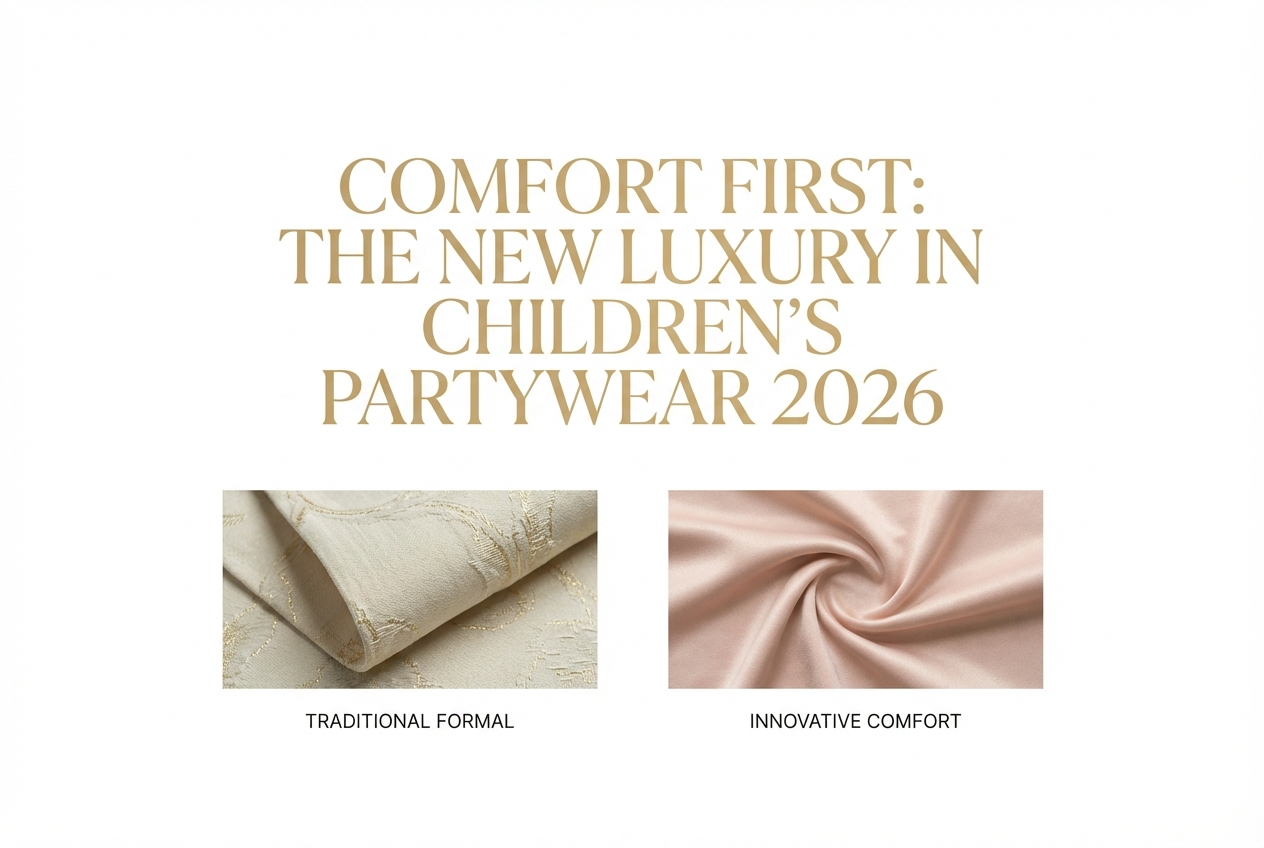
The first significant change was in fabrics. Textile manufacturers began developing materials that offered the visual elegance of traditional occasion-wear fabrics — the lustre of satin, the volume of tulle, the structure of taffeta — but with dramatically improved comfort properties. Soft-hand satins replaced stiff ones. Layered tulles became lighter and less scratchy. Cotton linings appeared where synthetic ones had previously dominated.
The second change was in construction. Seams became softer, waistbands gained elasticity, and bodices evolved from rigid scaffolding into gently structured supports. Tags moved from the back of the neck — that universally irritating position — to printed labels or side seams. These are small engineering decisions, but each one removed a potential source of discomfort.
The third and perhaps most important change was philosophical. Designers, retailers, and parents collectively began to question whether a dress that made a child miserable could truly be described as beautiful. The answer, increasingly, was no.
What Comfort Actually Looks Like in 2026
If you browse the current season's collection of party dresses, you will notice several hallmarks of this comfort-first approach.
The Stretch Revolution
Stretch fabrics have infiltrated occasion wear with remarkable success. This does not mean party dresses now look like athleisure — far from it. What it means is that a dress can look structured and elegant while incorporating just enough stretch in the bodice to allow a child to breathe deeply, eat enthusiastically, and raise her arms above her head without feeling restricted.
The technical term is "mechanical stretch" — fabric engineered to move with the body rather than against it. In girls' party dresses, this typically appears in the bodice, with a more traditional woven fabric used for the skirt. The result is a dress that photographs beautifully and wears like a dream.
The Rise of the Soft Waistline
The rigid waistband — that unforgiving strip of fabric that digs into a child's middle after twenty minutes of sitting — is slowly but surely disappearing. In its place, we see elasticated waists concealed beneath fabric, dropped waistlines that sit below the natural waist, and empire silhouettes that bypass the waist entirely. Each approach serves the same purpose: allowing a child to move, eat, and breathe without the dress becoming a source of physical discomfort.
Weight Reduction Without Sacrificing Volume
One of the cleverest innovations in modern children's formalwear is the ability to create voluminous, dramatic silhouettes using remarkably lightweight fabrics. Where a full-skirted party dress might once have weighed enough to tire a small child, contemporary designs achieve the same visual impact with layers of featherweight tulle and air. The dress looks substantial; it weighs almost nothing. A child wearing it can dance for hours.
The Parent Factor: How Adults Drive Design
It would be naive to suggest that this revolution is entirely about children's wellbeing. There is a strong commercial logic at work, and it is worth examining honestly.
Parents are the buyers, and parents have become more vocal, more informed, and more demanding. Online reviews have given consumers an unprecedented platform to share their experiences, and a dress that consistently draws complaints about discomfort will not survive in the market regardless of how beautiful it looks.
Moreover, the economics of children's clothing have shifted. Parents increasingly expect girls' party dresses to earn their place in the wardrobe through multiple wears rather than a single outing. A dress that a child refuses to wear twice — because it itches, pinches, or restricts — represents poor value, and value-conscious parents will not tolerate it.
This commercial pressure has, somewhat paradoxically, produced better design outcomes for children. When comfort becomes a selling point, innovation follows.
The Cultural Shift: Childhood Redefined
Beneath the fabric choices and construction techniques lies a deeper cultural change. Our collective understanding of childhood has evolved, and our clothing reflects it.
We no longer expect children to be miniature adults. We do not regard fidgeting as moral failure or running at a wedding as social catastrophe. We understand that a child's experience of an event is valid in its own right, and that experience is significantly diminished by physical discomfort.
This is not, as some commentators have suggested, a lowering of standards. It is a raising of expectations — specifically, the expectation that a beautiful dress should serve its wearer rather than constrain her.
What Remains Unchanged
For all the innovations in comfort, certain qualities remain non-negotiable in children's occasion wear. Elegance, beauty, and a sense of occasion are still paramount. A girls' party dress in 2026 must look special — it must mark the event as something distinct from an ordinary day. The artistry lies in achieving this sense of occasion through design, colour, and detail rather than through physical restriction.
A truly well-designed party dress today manages something that previous generations would have considered impossible: it looks like it belongs at a celebration while feeling like it belongs on a child. That dual achievement — beauty for the eyes and comfort for the body — is the defining characteristic of the current era, and it is, I would argue, the most significant advancement in children's formalwear in decades.
Looking Forward
Where does this trajectory lead? If the past decade is any indication, the integration of comfort into design will only deepen. We can expect to see further advances in fabric technology, more sophisticated construction techniques, and an ever-widening definition of what constitutes appropriate occasion wear.
What strikes me most about this quiet revolution is its fundamental generosity. It says to children: you deserve beauty and comfort simultaneously. You deserve to look wonderful and feel wonderful. You deserve a dress that enhances your experience of a celebration rather than detracting from it.
That, I think, is an idea worth celebrating in itself.
Explore the latest collection of girls' party dresses at ZOYA — where elegance meets comfort in every design.
Read also our similar articles:
- Girls' Party Dresses by Age: Choosing the Right Style from Toddler to Tween - https://www.zoyadresses.co.uk/blog/girls-party-dresses-by-age-toddler-to-tween-guide
- Summer Wedding Season Diary: Styling Girls' Party Dresses for Every Celebration - https://www.zoyadresses.co.uk/blog/summer-wedding-season-styling-girls-party-dresses
- How to Accessorise Girls' Party Dresses: A Busy Mum's Summer 2026 Guide - https://www.zoyadresses.co.uk/blog/how-to-accessorise-girls-party-dresses-summer-2026
- Sensory-friendly flower girl dresses and the shift towards comfortable children's formal wear - https://www.zoyadresses.co.uk/blog/sensory-friendly-flower-girl-dresses-comfortable-formal-wear
- Choosing sensory-friendly party wear for girls with sensitive skin - https://www.zoyadresses.co.uk/blog/sensory-friendly-party-wear-girls-sensitive-skin