

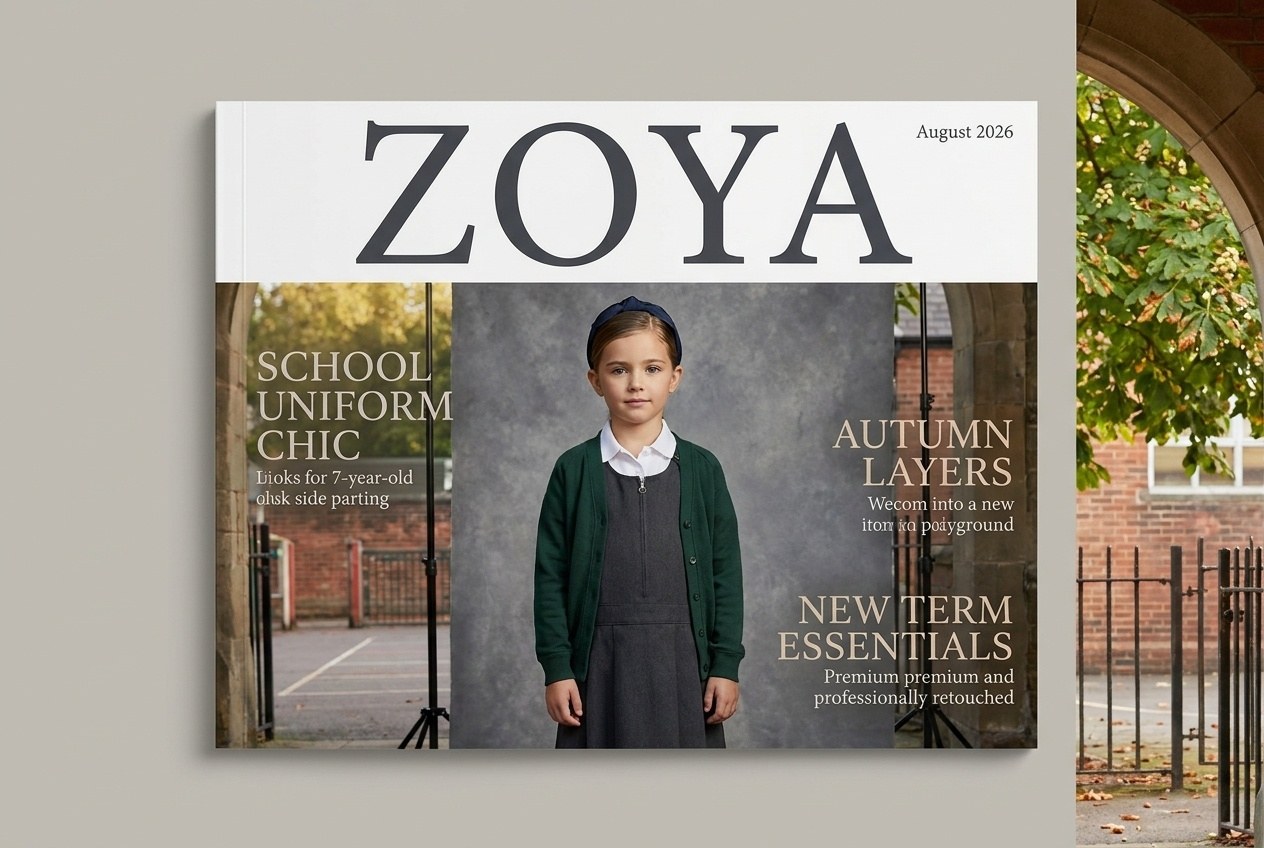
The Lens Never Flatters a Bow: A Critic's Verdict on Hair Bands and Hairpins This Autumn
I spent a September morning some years ago standing at the back of a draughty school hall in Hampshire, behind a photographer who had done this for twenty-three years and had the patience of a saint and the neck of a man who had bent over a tripod since 1998. One by one they came: reception, then Year One, then the big ones who no longer wanted to be there. And one by one, the mothers' most beautiful work quietly fell apart. A magnificent double-loop organza bow, plainly assembled with love at half past seven that morning, arrived on the monitor as a pale grey smear behind a small girl's ear, like a moth that had landed and declined to leave. The child was lovely. The bow was a catastrophe. That morning taught me more about hair bands and hairpins than a decade of runway shows, because a camera is the least sentimental critic in Britain: it does not care what a thing cost, who tied it, or how enchanting it looked in the hallway mirror. It cares only about edges, scale and light. So as the holidays end and the calendar fills with photographers, what actually survives the lens?
What a Camera Truly Does to a Ribbon
Begin with the cruellest mechanic, because everything else follows from it. A photograph is a flat translation of a round world, and the first casualty of that translation is volume. A bow is a three-dimensional object that reads to the eye as loops, shadow and turn. Reduce it to two dimensions and the loops collapse into one another; what remains is silhouette. This is why a bow that looks architectural in the hand so often reads as a blob in the print, and why organza, that most seductive of fabrics in daylight, is the single worst-behaved material in front of a lens. It is semi-transparent, so it takes on the colour of whatever sits behind it, which at a school photo is a mottled blue-grey canvas backdrop and at a family shoot is a hedgerow.
Then there is scale. School portraits are shot tight: head and shoulders, occasionally to the elbow. An accessory that occupies a modest fifth of a child's head in real life occupies a third of the picture. Nobody says, at the point of purchase, that you are not choosing a trinket but composing thirty per cent of an image destined for a grandmother's windowsill until roughly 2050.
Colour behaves badly too
Cameras and phones alike push saturated colours until they lose detail. A hot fuchsia bow arrives as a shape with no folds inside it. Muted, slightly greyed tones behave impeccably: sage, oatmeal, burgundy, ink navy, bitter chocolate, dusty rose. Is it any wonder that the most photogenic hair bands and hairpins are almost always the quietest ones in the drawer?
The School Portrait: Where Hair Bands and Hairpins Are Won and Lost
The English and Welsh terms restart in the first week of September, the Scottish ones have been running since mid-August, and Northern Ireland sits somewhere in between. What unites them is the photographer's van in the car park within a fortnight of the first day, and a letter home that most of us skim.
Read that letter properly, because it is a styling brief in disguise. The overwhelming majority of British schools require hair accessories to be plain and in school colours: navy, bottle green, burgundy, black, occasionally grey. Some specify a maximum size. A few ban bows above a certain width outright. This is not a constraint to resent; it is the best editing service you will ever be given free of charge. It removes precisely the pieces the camera hates and leaves you with the ones it loves.
What the tight crop rewards
A slim satin or grosgrain band, set roughly two centimetres back from the hairline, does something no bow can: it draws a clean, continuous curve across the top of the frame and lifts the fringe out of the eyes. Eyes are the whole point of a portrait. Anything that shadows them is a mistake, however pretty. A padded band in a matte fabric holds its shape through the long shuffle of the queue and does not slip forward when a child fidgets. And the humble pin, so often dismissed, is the quiet hero of picture day: two plain slides, crossed, hold a side parting flat against the head for four hours, which is roughly three hours and forty minutes longer than any bow manages.
My rule for the school portrait is severe and I stand by it. One piece, matte, in school colours, sitting flat. If you are choosing from a drawer of school-appropriate hair bands, pick the one you would notice least. That is the one that will photograph best.
The Autumn Family Shoot: Wind, Low Sun and an Honest Sensor
Then comes the other September ritual, the one that has quietly become a national institution: the family shoot in a wood, a park or a field of stubble, booked for the golden hour because somebody on Instagram said so. Here the physics change entirely and so should the accessory.
The first enemy is wind. British autumn light is glorious and British autumn air is never still. A loosely gripped clip migrates; an elasticated band rides up. By frame forty, half the children have accessories at an angle that will haunt the group shot for a generation. The fix is unglamorous: anything worn outdoors in October needs grip, which means a velvet or silicone-lined underside, or pins that actually bite. Smooth-backed decorative slides are for indoors and still air. They will not hold on Hampstead Heath.
The second is the low sun itself, and this is where things become genuinely interesting. Golden-hour light arrives sideways and rakes across everything, which is exactly why photographers chase it. Sideways light adores texture. Velvet, ribbed grosgrain, plaited cord, tiny fabric-covered buttons: all of these come alive because the raking light finds every fibre and every ridge. What it does not adore is glitter. A sparkling pin under low sun does not sparkle in the file; it produces small blown-out white dots the photographer will spend an evening retouching, and there is a particular sort of parental heartbreak in a beautiful frame ruined by three unfixable pinpricks of white.
So: texture over shine, grip over prettiness, and for a woodland shoot in a rust-and-moss palette, a warm neutral band that lets the trees do the colour work. Does a photograph of your child in an autumn wood really need a competing focal point on her head?
The September Aisle: Weddings, Christenings and the Backlit Nave
September is the peak of the British wedding calendar and has been for some years now, and it is also when the christenings that were postponed through the summer finally happen. Both take place in buildings designed centuries before anyone thought about exposure. The nave is dim, the east window behind the altar is blindingly bright, and the photographer is fighting a contrast range no sensor was built for.
Backlight is the defining condition. Stand a child with her back to a stained-glass window and everything on her head becomes silhouette. This is the one occasion where the rule about restraint bends, because in silhouette an outline is all you have, and an outline can be lovely: a slim band with a small side detail, a fine plaited halo, a single pin catching the rim light at the temple. What fails utterly is anything that relies on interior detail. That intricate beaded piece, whose whole charm is what happens in its middle, becomes a dark lump.
The flower girl problem
Flower girls walk. They walk for perhaps ninety seconds, and that ninety seconds is documented by two photographers and forty phones. An accessory chosen for a fitting-room mirror has to survive a car, a churchyard, a portico and an aisle. If it needs adjusting, it will not survive. The professional answer has always been the same: a secured band rather than a perched piece, and pins placed underneath as insurance rather than on top as decoration. For a christening, where the baby is horizontal and the crop is very tight indeed, softness matters more than structure; a fine knotted band with no hard edge photographs beautifully against a shawl and, more to the point, will not mark a scalp. The best occasion hair accessories for a church are the ones a child forgets she is wearing.
The Transitional Wardrobe and the Hair That Sits Above It
By late September the evenings turn and the whole styling problem shifts, because the accessory now has to answer to a layer it did not have to consider in July. This is the part most guides skip and it is the part that actually decides whether a photograph looks composed or accidental.
Consider what happens when a cardigan, a gilet or a first coat enters the frame. Suddenly there is a second texture near the face, and two textures near a face is the natural limit before an image starts to look busy. A cable-knit cardigan with a chunky plaited headband is one texture too many; the eye cannot decide where to rest. Pair the cable knit with a smooth satin band instead and the contrast does the work. Conversely, a flat wool coat with a velvet band is a proper piece of styling, because the velvet is the only thing in the frame with a pile to catch the light.
Then there is the collar, an object of surprising tyranny. Once a child is layered, a chunk of the neck disappears, the visible head-to-shoulder ratio changes and anything wide at ear level makes the whole figure read as top-heavy. Height is the answer, not width. A band that lifts hair up and back restores the line that the coat took away.
And a small, unromantic point no critic should be too proud to make: hoods. Anything worn on a British October morning must survive being flattened under one and emerge intact. Padded bands do. Elaborate perched pieces do not. A neat clip in a fabric that recovers, a plain slide, a narrow padded band from a well-chosen selection of padded velvet hair bands are all hood-proof. Isn't that, finally, a more useful test than whether a thing looks charming under shop lighting?
The Critic's Short List: What Earns Its Place This Autumn
So we arrive at the verdict, and the verdict is shorter than the drawer. Four seasons of school halls, damp churchyards and stubble fields have persuaded me that a girl needs perhaps five pieces this autumn, not fifteen. Here is what I would keep.
-
A slim matte band in a school colour. Navy, bottle green or burgundy, satin or grosgrain, worn two centimetres back. It complies with almost every uniform policy in Britain, it holds a fringe out of the eyes, and it photographs as a clean line rather than a shape. This is the picture-day workhorse.
-
A padded velvet band in a muted tone. The single most photogenic thing you can put on a child's head in low autumn sun, because pile and raking light were made for one another. It survives hoods, it grips, and it turns a plain wool coat into an outfit.
-
Two plain slides, in the child's own hair colour. Unromantic, invisible and indispensable. They hold a parting flat for hours and act as insurance under anything decorative. Buy four; you will lose two.
-
One fine occasion piece with a strong outline. For the September aisle and the christening: something whose silhouette reads against a bright window, secured rather than perched, with no interior detail it depends on. Choose it from the dedicated girls' hair bands and hairpins rather than borrowing from the party box.
-
One textured band with grip for outdoors. Plaited cord or ribbed knit, silicone-lined, warm neutral. This is the woodland-shoot piece and it is the only one allowed to have a personality of its own, because the background out there is doing enough already.
That is the list. Not a wardrobe, a working kit. Everything on it shares the same virtue, which is that it disappears into a good photograph and lets the child be the subject, and everything left out shares the same vice, which is that it competes. If there is one thing this autumn's calendar of portraits, shoots and church aisles will teach you, it is that the best hair bands and hairpins are the ones nobody remembers noticing, and the worst are the ones everyone does. Choose accordingly, and choose early, before the photographer's van is in the car park. Browse the full selection of hair bands and hairpins at ZOYA and build the five-piece kit now, while there is still time to see how it behaves in daylight.
Read also:
- Stylish and Practical Girls’ Hairstyles – Best Hair Accessories for Every Occasion
- First Day of School Dresses for Girls – Smart Styling Guide for 2024
- Wedding Accessories for Girls 2025 – Styling Tips & Must-Haves
- Keep Girls Warm in Style: Smart Dress Layering Tips for Autumn 2024
- How to Accessorise Girls' Party Dresses: A Busy Mum's Summer 2026 Guide