

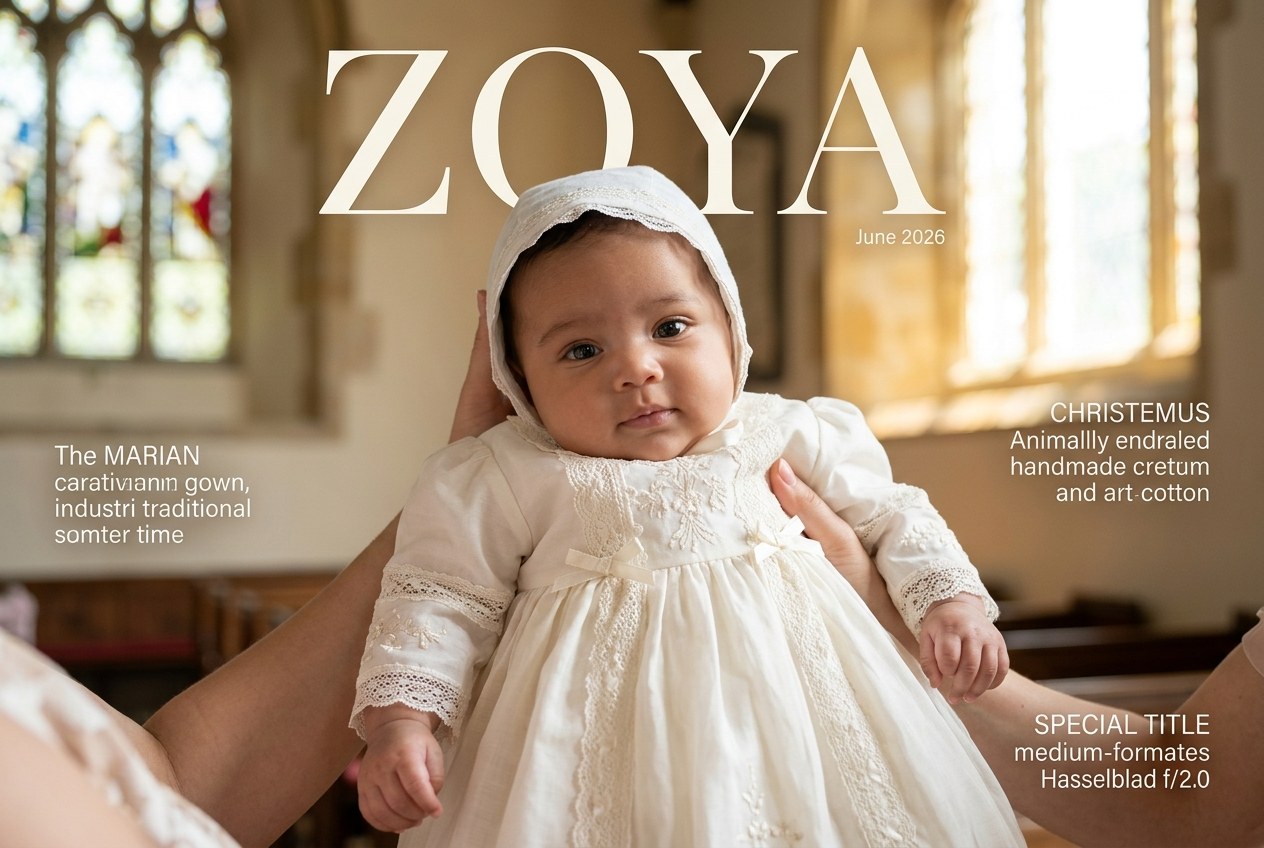
Christening Dresses: A Fashion Critic's Quiet Hour in the Vestry, and What It Taught Me About Dressing the Smallest Guest of Honour
The vestry smelled of beeswax and old hymn books. I had slipped in early, notebook in hand, ostensibly to "observe the proceedings" but really because the light through the leaded windows was doing something extraordinary to one of those long white christening dresses laid out across a chair. The mother was smoothing it with the flat of her hand, again and again, the way one smooths a tablecloth before guests arrive. And I thought, with the slightly embarrassing intensity I reserve for fabric: this is not just an outfit. This is a costume for the shortest play in the world, performed once, before an audience of relatives who will weep on cue.
I have spent the better part of two decades writing about how children are dressed, and I confess that nothing tests a critic's eye quite like christening dresses. Here is a garment worn by a person who cannot yet hold up her own head, photographed within an inch of its life, and expected to survive contact with a font of cold water. Is it any wonder that parents arrive at the question of what to choose with a mixture of reverence and mild panic? In this piece I want to walk you, slowly and with feeling, through what actually matters: the fabric, the cut, the colour, the practicalities, and finally the small art of accessorising. Pour yourself something. We are going to do this properly.
Why the Christening Gown Refuses to Go Out of Fashion
There is a stubbornness to the christening gown that I find genuinely moving. Hemlines rise and fall, shoulders pad and unpad, but the long white gown for a baby's baptism has remained more or less constant for the better part of two centuries. Why does it persist when so much else has been swept away? Because, I think, it does a job that no trend can improve upon: it announces, in the oldest visual language we have, that a new person has arrived and is being welcomed.
A short, affectionate history
The floor-skimming length we associate with classic christening dresses is itself a kind of inherited optical illusion. In the Victorian period the long gown signalled that an infant was, however briefly, the centre of a household's hopes. Lace, whitework and fine cotton lawn were the materials of the day, and many British families still keep a great-grandmother's gown wrapped in tissue. The garment was designed to be photographed, handed down, and remembered.
What strikes me, looking at the contemporary versions, is how little the brief has changed and how much the execution has improved. Modern fabrics breathe. Modern construction accounts for the fact that a baby will be held, jostled and very possibly sick down one shoulder. Is there anything more reassuring than tradition that has quietly learned to be comfortable? The gown endures not because we are sentimental, though we are, but because it works. It frames the smallest guest of honour without ever upstaging the moment itself.
How to Judge the Fabric of Christening Dresses: What Touches the Skin Matters Most
If you take one thing from this whole essay, let it be this: with a baby, fabric is not a finishing detail. Fabric is the entire conversation. An adult can suffer for fashion for an afternoon. A three-month-old cannot, and will tell you so, loudly, in the middle of the vicar's address.
So what should you be looking for? I always begin with the lining, not the outer layer, because the lining is what the skin actually meets. Pure cotton and cotton-rich blends are the gold standard here: soft, breathable, and forgiving of the warm British church that has had the heating on since dawn. Satin and silk-look fabrics photograph beautifully and catch the light in a way that flatters every snapshot, but I want them backed with a gentle cotton lining so that nothing scratchy ever reaches a delicate neck.
Reading a garment like a critic
When I assess elegant christening dresses, I run a quiet checklist that you can borrow. Are the seams flat and smooth on the inside? Is the closure at the back soft, with covered buttons or a discreet popper rather than a stiff zip against the spine? Does the lace, if there is lace, sit over a lining rather than directly against the skin? Is the weight of the gown appropriate to a June afternoon, when an over-engineered confection becomes a small portable greenhouse?
These are not glamorous questions, and that is precisely why they separate a beautiful photograph from a comfortable day. A baby who is too hot or itchy will not perform, and neither will a toddler. The genius of a well-made gown lies in the parts you never see. Have you ever turned a garment inside out before buying it? I promise you it is the single most useful, and most overlooked, gesture in the whole undertaking.
Colour, Cut and the Quiet British Palette
White, naturally. But which white? This is the sort of question that makes my friends roll their eyes and makes me very happy indeed, because there are at least a dozen, and they are not interchangeable. The choice of shade is the most personal decision in the whole exercise, and it deserves a moment of genuine thought rather than a hurried tap on a screen.
Ivory, blush and the case for restraint
Pure brilliant white is crisp and modern, and it reads beautifully against the cool grey stone of a typical British parish church. Ivory and antique white are softer, warmer, and kinder to most complexions, which is why so many heirloom christening dresses lean that way. Then there is the gentlest blush or palest champagne, increasingly popular for summer 2026, which photographs as "white" to the casual eye but adds a whisper of warmth in golden-hour light. Would I steer you towards drama? Never. The whole point of the baptismal palette is its restraint. The colour should murmur, not shout.
On cut, the rules are forgiving but real. For an infant, length is a virtue: the long gown drapes elegantly over an adult's arm and creates that timeless, cradle-of-civilisation silhouette. For an older baby or a toddler being christened, which is wonderfully common these days, a shorter A-line dress that allows for sitting, crawling and the occasional escape attempt is far more sensible. A high empire waist sits comfortably above a rounded baby tummy. A full skirt photographs gorgeously but should never be so stiff that it forces a small body into an unnatural pose. Elegance, in childrenswear, is always the elegance of a child allowed to be a child. Doesn't the most charming photograph always catch the one who looks entirely, gloriously at ease?
The Practical Theatre: Dressing for the Day Itself
Let me return you to that vestry, because the moment of christening is, in the most literal sense, a piece of theatre, and like all theatre it rewards rehearsal. The most beautiful gown in Britain will let you down if it cannot survive the choreography of the day.
A timeline I wish every parent had
Think through the running order. There is the arrival, often after a car journey in which the outfit must not crease into oblivion. There is the holding, the passing from godparent to grandparent. There is the water itself, applied to the forehead, which means you want a neckline and a fabric that will not show a damp patch as a permanent scar. There is, almost inevitably, a feed and possibly a change in the middle of it all, which is why the truly clever smart christening dresses open fully at the back or layer over a simple bodysuit you can swap without an undressing drama.
I am a great believer in the second outfit, by the way. Keep the heirloom gown immaculate for the ceremony and the formal photographs, then change into a softer, simpler dress for the lunch, the cake and the inevitable smearing of buttercream. Does that sound like overthinking? Perhaps. But I have watched too many parents spend the reception terrified of a stain, when they could have been enjoying the day. Plan the costume change in advance and you reclaim the celebration.
A final practical word on shoes and warmth. For the very young, soft booties or simple socks are far kinder than structured shoes, which serve no purpose on feet that do not yet walk. For toddlers, a soft ballet-style pump in ivory keeps the line clean. And in a British church, even in June, a fine cotton cardigan or a delicate wrap is not a fashion statement but an act of mercy.
Accessorising the Smallest Guest of Honour, and a Few Parting Thoughts
Now for the part I enjoy most, the styling, with one firm rule: on a baby, less is always more. The garment is the statement. Everything else is punctuation. A delicate bonnet or a simple lace headband finishes the look without competing with it. A fine knitted shawl, ideally an heirloom one, adds warmth and a layer of family history in a single gesture. A small cross or a christening bracelet, often a gift from godparents, carries meaning far beyond its size.
Resist, I beg you, the temptation to over-decorate. The most exquisite christening dresses I have ever photographed were styled with almost nothing at all, because their makers understood that a baby's face needs no framing more elaborate than soft white fabric and good light. Is the eye not always drawn to the child rather than the trimmings? It is. That is the whole secret. Trust it.
So here we are, back where we began, in a vestry full of beeswax and anticipation. The gown is no longer just an object on a chair. It is a welcome, a photograph for the mantelpiece, a thing to be folded away and perhaps unfolded again in a generation. Choose it with your head and your heart in equal measure, and it will do everything you ask of it.
To send you off with something useful, here is what I would press into your hands as you go:
- Turn the gown inside out before you buy. Smooth seams, a soft lining and a gentle back closure matter more than any flourish on the front, and they are the truest test of quality in christening dresses.
- Choose your white deliberately. Crisp white, warm ivory or the palest blush each tell a different story; let the light of a June ceremony, and your baby's complexion, guide you among the christening gowns and dresses.
- Match the cut to the age. A long gown for an infant, a forgiving A-line for a toddler who needs to move, and an empire waist for comfort across the celebration.
- Plan a second outfit. Keep the ceremony piece pristine for the photographs, then change into something soft for the lunch, and reclaim the day from the fear of stains.
- Accessorise with restraint. A bonnet, a shawl, a christening bracelet, and nothing more.
When you are ready to begin the loveliest part, the choosing, browse our considered edit of christening dresses for girls and find the gown that will carry your smallest guest of honour gently through her biggest little day.
You might also like to read