

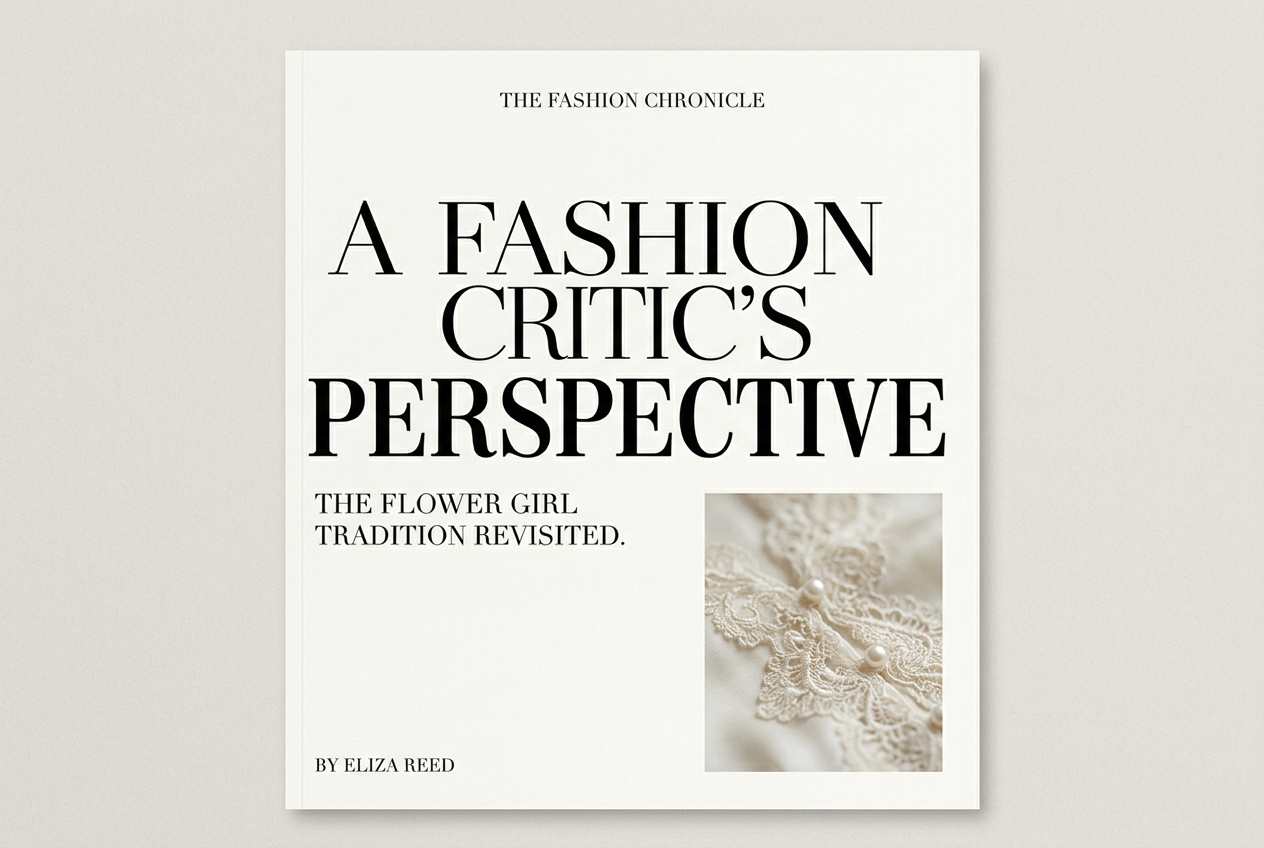
Why the Flower Girl Steals the Show: The Unwritten Rules of Wedding Fashion for Little Ones
I have a confession to make. At every wedding I have ever attended, the moment that genuinely makes me catch my breath is not the bride's entrance. It is the flower girl.
There she is, three feet tall, clutching a basket that is almost as big as she is, walking down an aisle with the kind of unscripted confidence that no adult could ever replicate. Sometimes she walks too fast. Sometimes she sits down halfway. Sometimes she waves at her grandad with such enthusiasm that half the petals end up on one pew. And every single time, the entire room melts.
But here is what fascinates me as someone who has spent years studying the mechanics of fashion: the flower girl is not just a charming addition to the wedding party. She is, arguably, the most interesting fashion moment of the entire ceremony. And nobody talks about why.
The Accidental Fashion Icon
Let us start with a question that seems simple but is anything but: why do we dress small children in formal occasion wear for weddings?
The tradition of the flower girl dates back to ancient Rome, where young girls would walk ahead of the bride carrying bundles of wheat and herbs, symbols of fertility and prosperity. The flower girl dress as we know it today, that miniature echo of bridal elegance, emerged in the Victorian era, when the Romantic movement transformed weddings into the theatrical productions we recognise today.
What is remarkable is how the role has evolved while maintaining its essential tension: a flower girl is simultaneously part of the formal wedding tableau and entirely outside it. She wears a dress chosen with care and intention, yet she inhabits it with the beautiful indifference that only a child can manage. She is dressed for a ceremony but exists in a world of her own, and that contradiction is precisely what makes her so captivating.
This is, I would argue, the purest form of fashion: clothing worn without self-consciousness, where the garment serves the person rather than the other way around.
The Unwritten Dress Code Nobody Discusses
Every wedding has an unwritten dress code for the flower girl, and it is far more nuanced than most people realise. Having observed dozens of weddings and spoken to countless parents, stylists, and bridal consultants, I have identified a set of rules that operate almost invisibly.
Rule one: complement, never compete. The flower girl's dress should exist in visual harmony with the bride's gown without mimicking it too closely. A miniature replica of the bridal dress, once popular in the early 2000s, now feels dated and, frankly, a little unsettling. The contemporary approach is subtler: shared colour palettes, complementary fabrics, or echoing a single design element like lace detailing or a ribbon sash.
Rule two: respect the venue. I once saw a flower girl in a full-skirted ball gown at a casual beach wedding. The dress was beautiful in isolation, magnificent even, but in context it looked like a costume from a different production entirely. The best flower girl dresses understand their setting. A cathedral calls for something with structure and formality. A garden party invites something lighter, softer, more forgiving.
Rule three: the comfort imperative. Here is where fashion theory meets the unyielding reality of children. You can design the most exquisite dress in the world, but if it itches, restricts movement, or involves a zip that digs into small ribs, the result will be tears rather than twirls. I have always believed that comfort is not the enemy of elegance but its foundation, and nowhere is this more evident than in children's occasion wear.
The Fabric Question: Where Art Meets Engineering
If you will permit me a brief detour into the technical, let us talk about fabric. Because the choice of material in a flower girl dress is where artistry and engineering collide in the most fascinating way.
Consider tulle. It is the fabric most associated with flower girl dresses, and for good reason. Layers of tulle create volume and movement that photograph extraordinarily well. When a flower girl twirls, the skirt floats and settles like a slow-motion dream. It is visual poetry.
But tulle is also a fabric that demands intelligent construction. Without a proper lining, it can be abrasive against young skin. Without the right number of layers, it either falls flat or becomes unwieldy. Getting the balance right is a genuine craft, and the difference between a well-made tulle flower girl dress and a poorly made one is immediately visible, even to the untrained eye.
Then there is cotton, the quietly heroic fabric that rarely gets the credit it deserves in occasion wear. A beautifully cut cotton dress with considered details, a covered button here, a French seam there, can look every bit as elegant as satin while being infinitely more comfortable. I have long believed that cotton is the thinking parent's choice for summer weddings, and the market is finally catching up.
Satin, meanwhile, remains the fabric of choice for formality. Its reflective surface catches light in a way that creates instant glamour. But satin on a five-year-old at a July wedding is an act of optimism bordering on recklessness. Know your venue, know your weather, know your child.
The Colour Conversation
White remains the default for flower girl dresses in the United Kingdom, but the conversation around colour is shifting in interesting ways. Blush pink has established itself as a credible alternative, soft enough to read as ceremonial but distinctive enough to separate the flower girl from the bridal party. Ivory, champagne, and dusty rose are all gaining ground.
What interests me more is the growing confidence in bolder choices. I attended a wedding last autumn where the flower girl wore a deep burgundy velvet dress that matched the seasonal foliage in the venue's courtyard. It was unexpected, sophisticated, and completely stunning. The child looked like she belonged in a Renaissance painting, which, given the setting of a Cotswolds manor house, was entirely appropriate.
The key, I think, is intentionality. Any colour can work if the choice is deliberate and considered within the broader visual narrative of the wedding. What does not work is randomness, choosing a colour because it was on sale or because it happened to be available in the right size.
The Accessory Paradox
Here is something I find endlessly amusing about flower girl fashion: the accessories are simultaneously the least important and most important element of the entire look.
Least important because a well-chosen dress needs very little embellishment. A child's face, with its unguarded expressiveness, is the most compelling accessory any outfit could have. No headband, no crown, no carefully curated basket of petals can compete with the genuine delight of a four-year-old who has just realised she is the centre of attention.
Most important because the wrong accessory can undermine everything. An overly elaborate headpiece that obscures a small face. Shoes so stiff they transform a confident walker into a tentative shuffler. A basket so large it becomes an impediment rather than a prop. I have seen all of these, and they share a common error: prioritising the visual over the practical.
The best flower girl accessories are invisible in the best possible way. They complete the look without drawing attention to themselves. A simple flower crown that sits naturally. Ballet flats that allow unrestricted movement. A posy or basket that a small hand can manage with ease. These are the choices that allow the child, not the outfit, to be the star.
Why It Matters: Fashion as Storytelling
I realise I have spent rather a lot of words on what some might dismiss as a minor detail of wedding planning. But I would push back on that characterisation, because the flower girl represents something important about how we use fashion to tell stories.
A wedding is, at its heart, a narrative event. It tells a story about two people, their families, their values, and their vision of the future. The flower girl is part of that narrative. She represents innocence, joy, continuity, the idea that love extends beyond the couple at the altar to encompass families and generations.
The flower girl dress she wears communicates all of this without a single word being spoken. A dress chosen with care says: this child matters to us. She belongs in this story. She is not a prop or an afterthought but an essential part of the celebration.
And when that dress is comfortable enough to let her be fully, gloriously, unself-consciously herself? That is when fashion achieves something genuinely beautiful.
The Final Word: Let Her Steal the Show
If you are choosing a flower girl dress for an upcoming wedding, here is my advice, distilled from years of observation, analysis, and more than a few moments of being genuinely moved by a small person in a beautiful outfit.
Choose quality over quantity of detail. A well-made dress in a beautiful fabric will always outperform an over-embellished one. Prioritise comfort with the same rigour you would apply to aesthetics. Consider the setting, the season, and the child's personality. And then, once she is dressed, let her be.
Because the real magic of a flower girl is not in the dress. It is in the unscripted, unrehearsed, utterly authentic way a child inhabits a moment of celebration. The dress is simply the frame. The masterpiece is already there.
Explore our collection of thoughtfully designed flower girl dresses that balance elegance with comfort, because every little girl deserves to feel as wonderful as she looks.
You might also enjoy these articles: